See your website’s legal exposure in minutes.
Class-action lawyers crawl your site daily. We find the same violations they do, with cited case law, before they do.
Recently settled, a sample
 $275M
$275M $150M
$150M $95M
$95M $92M
$92M $90M
$90M $52M
$52M $19.99M
 $19M
$19M $16.5M
 $16M
$16M $16M
$16M $5.8M
$5.8M $375K$275M$150M$95M$92M$90M$52M$19.99M$19M$16.5M$16M$16M$5.8M$375K
You don’t have to be big to get sued.
These are the numbers your business is operating inside, not projections, filings.
- 01
- 25,000+
- Federal compliance suits, 2020-2024
- 02
- $1.2M
- First CCPA enforcement (Sephora, 2022)
- 03
- $2,500
- Per-video VPPA damages
- 04
- $500-$1,500
- Per-text TCPA damages
Federal filing counts from Seyfarth Shaw’s ADA Title III year-in-review, WebRecon TCPA statistics, and Duane Morris’s BIPA & VPPA litigation reports. Statutory damages from 18 U.S.C. § 2710 (VPPA) and 47 U.S.C. § 227 (TCPA). Excludes CIPA session-replay, FTC enforcement, state AG actions, and state-court filings, the true total is meaningfully higher.
We run the same scan a plaintiff’s firm runs.
The only difference is who reads the results first, you, or the lawyer who sends the demand letter.
We crawl your site
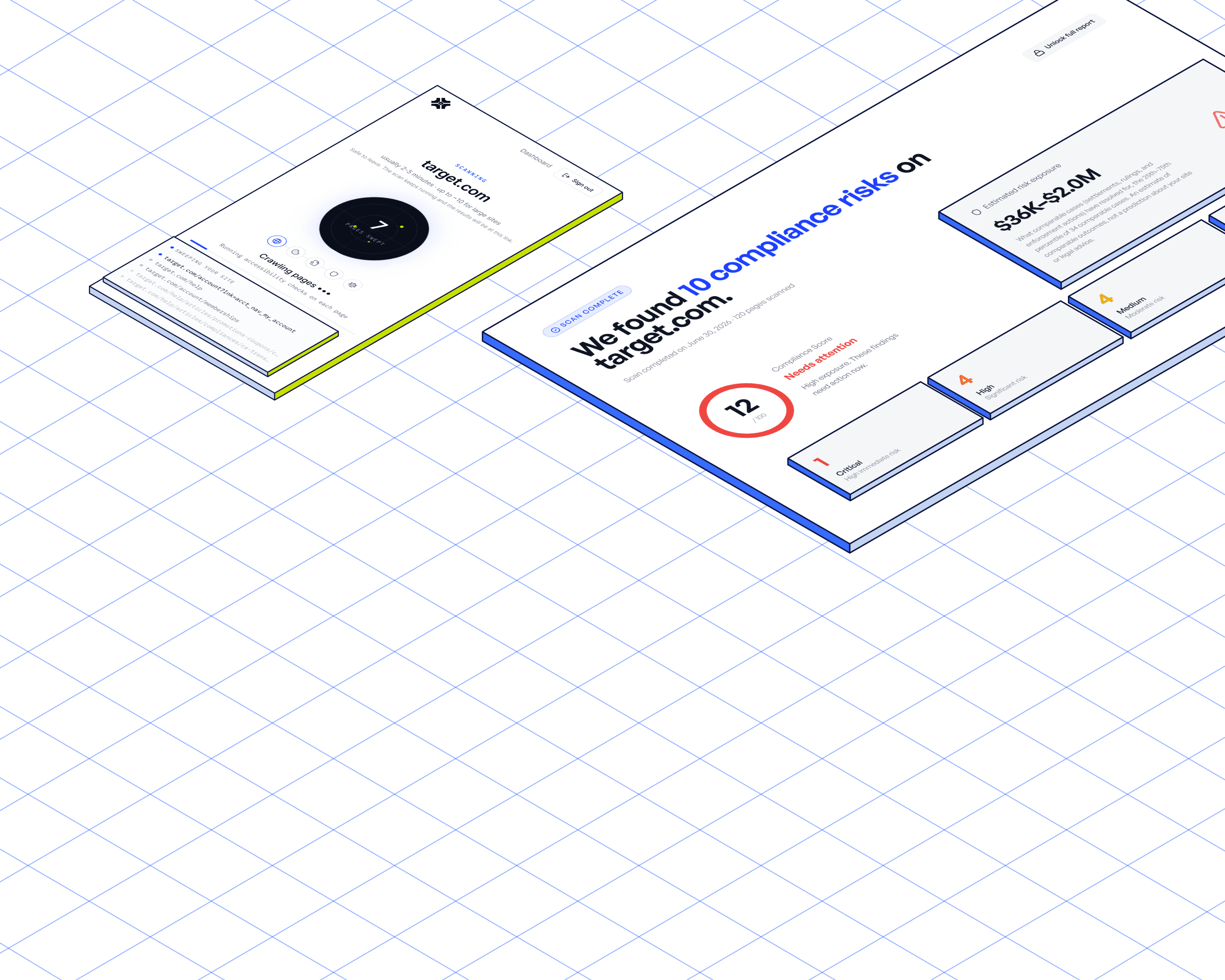
We open every page, up to 120, and capture every tracker, cookie, third-party script, and form. It’s the same sweep a plaintiff’s investigator runs before drafting a complaint.
We run 22 checks
We look for what actually gets sites sued: tracking that fires before someone consents, pages a screen reader can’t use, subscriptions built to be hard to cancel, video that leaks what people watch, and more, the violations behind CCPA, ADA, VPPA, and TCPA claims. Every finding is matched to a real settled case.
You read the report first
Every finding cites a real case, and every dollar traces to a real settlement on the public record. You get it in minutes, long before a demand letter could.
Every company on this list believed it was compliant.
Until a scan turned up the violation. Complidar cross-references your findings against a database of settled cases, every figure links straight to the court document, AG release, or consent decree.
$8B+
recovered across 250+ cited settlements in 20+ jurisdictions, every one a public-record case for the exact violations we scan for.
Filing range2008 → 2026
$925,000,000
Wakefield v. ViSalus, Inc.
TCPA / Unsolicited contactUnsolicited prerecorded calls at $500 apiece. The jury counted 1.8 million of them. The math is not on the defendant’s side.
51 F.4th 1109 (9th Cir. 2022)
$150,000,000
U.S. v. Adobe Inc.
ROSCA / Auto-renewalHidden cancellation fees and a cancel flow built to obstruct. The FTC's 2024 complaint under ROSCA settled with the DOJ in March 2026: $75M in penalties, $75M back to consumers.
DOJ consent judgment (2026)
$12,500,000
Markels v. AARP
VPPA / Meta PixelThe Meta Pixel on AARP.org video pages disclosed what each member watched. The court approved a $12.5M settlement, VPPA pegs statutory damages at $2,500 per viewer.
4:22-cv-05499 (N.D. Cal. 2026)$1,500,000
Javier v. Assurance IQ
CIPA / Session replayThe Ninth Circuit ruled that session-replay scripts can be wiretaps. Every recorded visit on a California site is now a potential claim.
21-16351 (9th Cir. 2022)
$1,200,000
In re Sephora USA
CCPA / Tracker consentThe first CCPA enforcement action. Sephora’s violation: trackers that fired before consent and ignored the browser’s Global Privacy Control signal.
Cal. Att’y Gen. (2022)
$325,000
Robles v. Domino’s Pizza
ADA / Web accessibilityThe Supreme Court let it stand: an inaccessible website is a violation of the ADA. Domino’s fought it for four years and lost.
913 F.3d 898 (9th Cir. 2019)Sourced from PACER federal dockets · California AG enforcement · FTC consent decrees · DOJ ADA settlement letters · class-action verdict approvals.
Your scan is free. Your exposure isn’t.
Every plan starts with the same free scan. You only pay when you’re ready to see exactly what a plaintiff’s firm would, and fix it before they do.
Sephora paid $1.2M for ignoring privacy opt-outs.
The audit that catches the same gap is $39.
Free Scan
See your violation count, severity breakdown, and an estimated liability range. No account, no card.
- Violation + severity breakdown
- Estimated liability range
- Up to 120 pages crawled
One-Time Audit
Unlock one full report, every finding, the evidence behind it, the cited settlement, and the fix.
- Everything in Free Scan
- All findings + evidence unlocked
- Cited settlement data per finding
- Plain-English remediation steps
- Exportable report
Find nothing? It’s free.
Monthly Monitoring
Compliance isn’t a one-time fix. Every deploy, tracker, or policy edit can open fresh exposure. We re-scan every 2 weeks and flag it the moment it does.
- Everything in One-Time Audit
- Automatic re-scan every 2 weeks
- Alerts when new risk appears
- Full audit history + trend dashboard
- Priority support
Cancel anytime.
Fix It For Me
Don’t just find the violations, hand them over. Our compliance team drafts the actual fixes, attorney-reviewed, ready for your counsel to sign off.
- Everything in Monthly Monitoring
- Attorney-reviewed remediation drafts
- Privacy policy, ARIA, consent & ToS copy
- PDF + Markdown delivery
- One-week delivery SLA
The Zero-Findings Guarantee
If a scan surfaces no compliance issues above our confidence threshold, your audit is free, no follow-up, no questions. We price on what we find, not on what we promise.
We can only see so much. A walkthrough makes sure you’re safe.
The scan reads your public pages. A Guided Compliance Walkthrough is a person walking the gated flows it can’t reach, your signup, subscription, and cancellation, from $499.
Cancel anytime · No card required to scan · Secure checkout via Stripe
Monitoring a portfolio of sites? Talk to us →The questions owners and counsel ask first.
What is Complidar?
Complidar is a website compliance scanner for small businesses. It crawls up to 120 pages of a site and runs 22 checks, covering ADA/WCAG accessibility, CCPA and state privacy laws, GDPR, VPPA video tracking, session-replay wiretap risk, auto-renewal (ROSCA), TCPA, and more. It then prices the exposure with liability ranges drawn from 250+ real, cited settlements. A scan takes minutes and the preview is free.
Is this legal advice?
No. This is an automated diagnostic tool. Every report carries a disclaimer telling you to consult a licensed attorney before acting. We surface the risk; counsel decides the response.
Do you actually scan my site, or just guess?
We send a real headless Chromium browser, capture every network request and cookie, run axe-core for WCAG checks, fetch your privacy policy and ToS, and feed them to Claude with a structured, evidence-grounded prompt.
What happens to my customers’ data during a scan?
We never log in. We crawl public pages only. Captured HTML and screenshots land in your private Supabase bucket, visible to you, after payment, and no one else.
How do you know the dollar amounts are real?
We never invent settlement numbers. Every finding is matched against documented cases, Sephora, Disney, Equifax, Epic Games, BetterHelp, and more. The range we cite is the 25th-to-75th-percentile of the comparable settlements those violations have drawn, a range of comparable outcomes, not a prediction about your site.
My site has hundreds of pages. Is that enough coverage?
The free scan follows links across up to 120 pages, enough to surface the systemic issues, since trackers and policies are usually site-wide. Monthly Monitoring raises the cap and re-scans every 2 weeks.
What is a website compliance scanner?
A website compliance scanner is an automated tool that crawls a site and checks it against legal requirements: accessibility standards (ADA/WCAG), privacy laws (CCPA, GDPR), marketing rules (TCPA, CAN-SPAM), and consumer-protection rules like auto-renewal laws. Complidar runs 22 such checks and attaches settlement-cited liability ranges to what it finds, so you see both the violation and what comparable cases have cost.
How do I check if my website is ADA compliant?
Run an automated WCAG scan: it loads your pages in a real browser and tests them against the accessibility criteria courts reference in ADA web cases. Complidar's free scan does this with axe-core across up to 120 pages and flags the barriers plaintiffs' firms cite most. Automated checks catch many violations but not all of them. Full conformance still needs human review, and your report says so honestly.
Can a small business get sued over website accessibility?
Yes. Federal website-accessibility filings reached 3,117 in 2025 (Seyfarth Shaw), and roughly two-thirds of the companies sued make under $25M in revenue (UsableNet). Small businesses also receive a large share of the demand letters that never become public filings. Robles v. Domino's settled the question of whether the ADA covers websites: it does. Complidar surfaces the same accessibility barriers those suits cite, before the letter arrives.
How do I check if my website violates the CCPA?
The most common CCPA violations are mechanical and detectable: trackers that fire before consent, ignoring the browser's Global Privacy Control signal, and a privacy policy missing required disclosures. That is the exact pattern behind the $1.2M Sephora enforcement. Complidar captures every tracker and cookie on your pages and checks all three automatically.
What does a website compliance scan cost?
A Complidar scan is free and shows your violation count, severity breakdown, and an estimated liability range. No account, no card. The full report (every finding, the evidence, the cited settlement, the fix) is a one-time $39, and continuous monitoring is $29/month. If a scan finds nothing above our confidence threshold, the audit is free.
How long does a website compliance scan take?
A few minutes. Complidar crawls up to 120 pages with a real headless browser, runs all 22 checks, and typically delivers the report in under ten minutes, long before a demand letter could.